



← Back to Insights & Resources
How to Daylight Canada’s Premier Dance Facility in a Century-Old Heritage Building
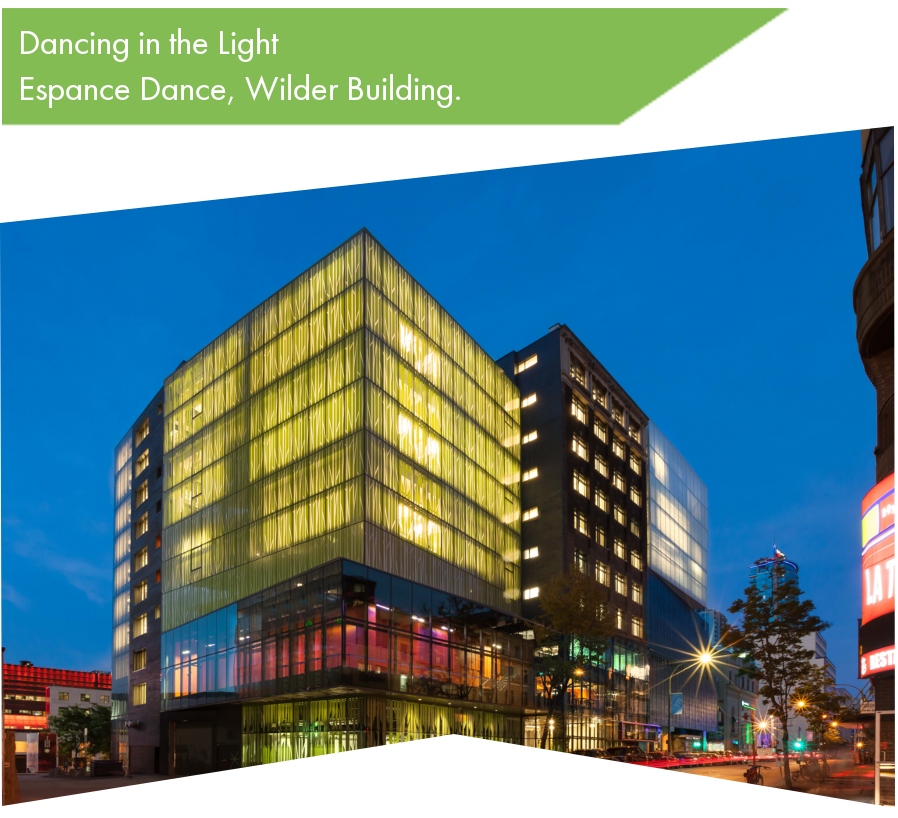
Maintaining the integrity of a century-old, 10-storey historic property while undergoing rehabilitation and expansion is no easy feat. Now add the challenge of maximizing daylight for dance studios—where parts of the academies have no artificial light—while honouring the heritage of the Wilder Building in Montreal. For Espace Danse, architects Lapointe Magne and Associates and Aedifica needed a solution that would control daylight density, reduce heat gain, and create a whimsical exterior that changes with the light.
The end work is a unique masterpiece that combines technical performance with artistic expression. As you walk around the exterior of the building, the colours and dimensions are constantly changing depending on where the light lands on it.
❌ The Heritage Dance Facility Challenge
This project presented a unique combination of constraints:
- Century-Old Heritage Property: A 10-storey historic building requiring rehabilitation and expansion while maintaining architectural integrity and honouring the heritage of the location.
- No Artificial Light in Parts of Academies: Some dance studios were designed to have no artificial light, making controlling the density of daylight absolutely critical for functionality and comfort.
- Heat Gain in Dance Studios: Dance studios generate significant heat from activity. Adding solar heat gain from glazing would make the spaces uncomfortable and compromise energy efficiency.
- Visual Identity for Dance Groups: The building needed to identify different dance groups while creating a unified, whimsical aesthetic that honours the artistry of Canada’s premier dance facility.
- Energy Efficiency Mandate: The project was targeting a silver certificate in energy efficiency, requiring exceptional thermal performance.
✓ The Solution: Solera® with Custom Silk-Screened Patterns
Architects Lapointe Magne and Associates and Aedifica partnered to create a space fit for Canada’s premier dance companies. They selected Solera® T-R5 as one of the core materials, combined with stunning custom silk screens to create a unique and whimsical effect that provides perfect natural light.
The Innovation: “Unique patterns were used through a fired-on silk screening method over the Solera® to identify the dance groups and to diminish heat gains within the dance studios,” shares Robert Magne of Lapointe Magne and Associates.
The Benefits:
- Controlled Daylight Density: Critical for studios with no artificial light, ensuring optimal illumination without glare
- Reduced Heat Gain: Silk-screened patterns diminish solar heat gain, keeping dance studios comfortable
- Improved Thermal Performance: Contributed to achieving a silver certificate in energy efficiency
- Visual Identity: Custom patterns identify different dance groups while creating a unified aesthetic
- Dynamic Exterior: Colors and dimensions constantly change depending on where the light lands, creating a whimsical, ever-changing façade
The Proof: A Whimsical Masterpiece That Honours Heritage and Artistry
“We were very pleased with how this project came together. This was a very complex project,” says Robert Magne. “We wanted to ensure it was done right while honouring the heritage of the location and the current building. Solera® was the perfect choice.”
The result is a building that performs as beautifully as it looks. The combination of Solera® T-R5 with custom silk-screened patterns achieves multiple goals simultaneously:
1. Technical Performance: Controls daylight density for studios with no artificial light, reduces heat gain, and improves thermal performance to achieve silver certificate in energy efficiency.
2. Artistic Expression: Creates a dynamic, whimsical exterior where “the colours and dimensions are constantly changing depending on where the light lands on it.”
3. Heritage Respect: Maintains the integrity of the century-old, 10-storey historic property while enabling modern functionality.
4. Identity & Community: Custom patterns identify different dance groups, creating a sense of place and belonging for Canada’s premier dance companies.
Why Light Diffusion Matters for Dance Studios
Light diffusion is a desired interior design technique and is by far the most effective method for creating a comfortable and visually pleasing naturally-lit environment. It’s not the light itself that impacts an environment, but the systems and materials that accompany and interact with the light that produce this effect.
How Diffusion Works: Diffusion breaks straight beams of light from the source, scattering them in different directions and producing a glow, rather than a shine. Its purpose is to mimic soft natural light from the sun (diffused naturally by clouds and the atmosphere), eliminate harsh shadows, offer larger expanses of continuous illumination, and ultimately improve aesthetics and occupant comfort.
A Critical Distinction: Diffused light does not always mean less light. Most methods and degrees of light diffusion yield a bright and useful space, with less intensity. Contrast and uneven illumination are completely eliminated—essential for dance studios where performers need consistent, comfortable light throughout the space.
The Takeaway: When Technical Performance Meets Artistic Expression
Heritage buildings present unique challenges—you must respect the past while enabling modern functionality. For specialized facilities like dance studios, the challenges multiply: you need controlled daylight density, reduced heat gain, energy efficiency, and an aesthetic that honours the artistry of the occupants.
Espace Danse at the Wilder Building proves that with the right daylighting solution and creative customization (like fired-on silk-screened patterns), you can create buildings where technical performance and artistic expression work together—where the façade changes with the light, the studios function without artificial lighting, and the heritage of a century-old building is honoured.