



← Back to Insights & Resources
Why You Can’t Use Vision Glass in a 100-Meter Indoor Turf Field
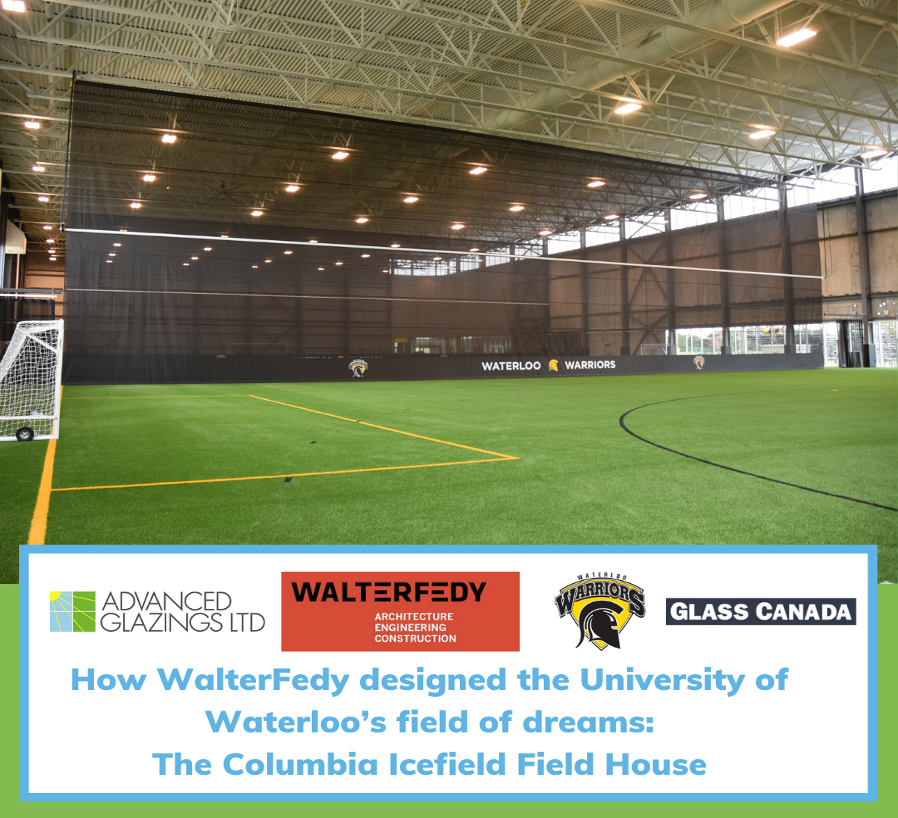
When the University of Waterloo set out to build a massive indoor turf field (100 by 50 meters), they knew they needed natural daylight. But vision glass would create uneven light distribution and glare that would negatively impact players. The solution had to deliver even, glare-free daylight while integrating seamlessly with the campus master plan.
The University envisioned a building that would be an optimal facility for their athletes but also a place for all students to grow and challenge themselves. One of the design goals was for the new facility to connect with the existing buildings on campus and integrate with the overall future master plan.
Enter the team at WalterFedy to help them make their vision a reality.
❌ The Indoor Turf Field Daylighting Challenge
From the beginning, Project Architect Ali Rawi of WalterFedy identified three critical challenges:
- Campus Integration: The building had to integrate with existing facilities and the future master plan, including material integration, color scheme of exterior elevations, playing turf, and section dividers.
- Vision Glass Won’t Work: Although vision glass might meet thermal goals, it would fail on glare, visual comfort, and thermal performance—creating uneven distribution of natural light and negatively impacting players and users.
- Strategic Daylighting: The location of daylighting had to be strategically planned to control the sun’s glare and heat to ensure the usability of the space is always maintained.
✓ The Solution: Engineered Daylight Diffusion on the Southeast Elevation
While searching for a daylighting solution, Ali Rawi recalled his colleague recommending Solera® by Advanced Glazings, as they had used it before in previous project installations.
“Solera® engineered daylight diffusers checked all the boxes for us,” says Rawi. “Solera® was able to distribute daylight evenly throughout the space without affecting the users’ ability to play. This was the main reason we chose Solera® for this space.”
Strategic Placement: Solera® was located in the Southeast elevation. “We chose not to place Solera® in the Northwest elevation because natural light wasn’t a concern from that direction,” explains Rawi.
Seamless Integration: “We got samples and agreed on the configurations of Solera® to connect with the existing building and location of the daylighting units for a seamless integration into this space.”
The Proof: Even Daylight in Both Configurations
The turf field measures 100 by 50 meters and can be divided into three separate areas, allowing for multiple sporting events at once. Project Architect Ali Rawi visited the sport field twice after construction completion.
“The first time, the space was open as one full playing field, and the second time, the space was divided into three different playing fields. Both times, the natural daylight performed very well for players and users in this space,” says Rawi.
“The natural daylight from Solera® integrated wonderfully with the other colors in the space, including the dividing curtain with the University logo and the playing field glass.”
A Homecoming for Solera® Technology
This project holds special significance for Advanced Glazings. Solera® technology began its roots in the University of Waterloo’s Engineering Solar Research Laboratory, where our Founder, Dr. Douglas Milburn, did his graduate work and was also a member of the varsity rugby team.
This new field house is a wonderful addition to the University of Waterloo, and we’re excited for students to experience it now and well into the future.
The Takeaway: Indoor Sports Facilities Need Even, Glare-Free Daylight
For large indoor turf fields and sports facilities, vision glass creates more problems than it solves. Uneven light distribution and glare negatively impact players and compromise the usability of the space.
The University of Waterloo Field House proves that with engineered daylight diffusion, you can create athletic facilities where natural light enhances performance rather than hindering it—while seamlessly integrating with your campus master plan.