



← Back to Insights & Resources
How to Daylight a School Gym When the #7 Train Runs Right Next Door
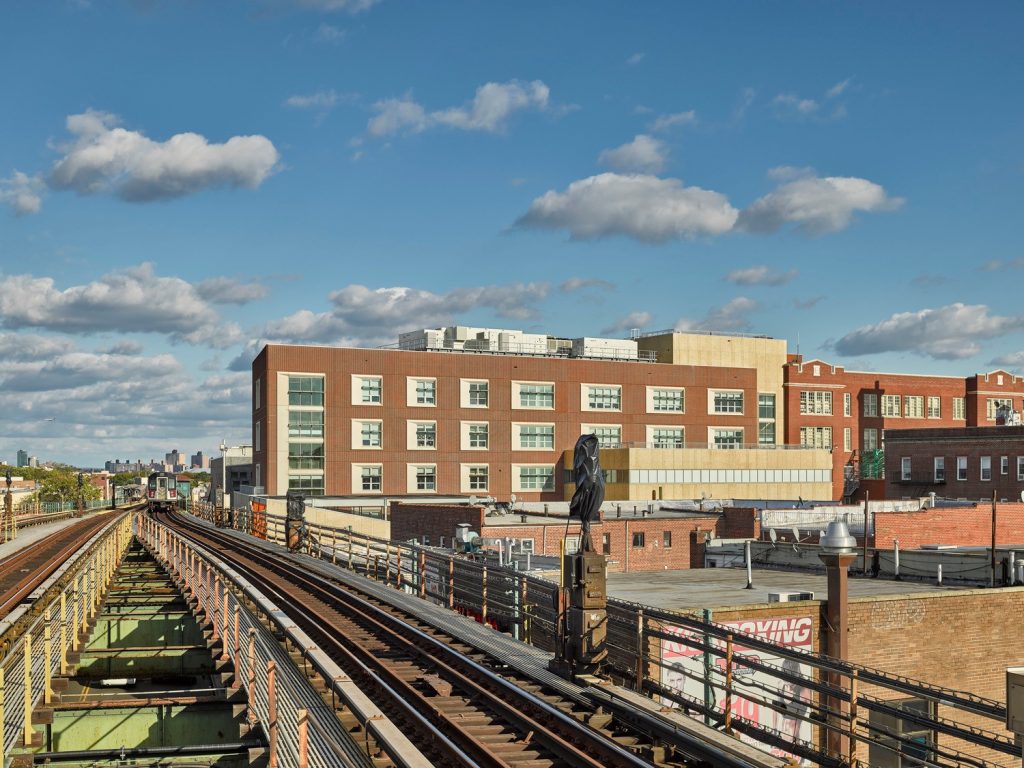
In the heart of Queens, Marino Jeantet School (PS19) is nestled in the hustle and bustle of New York—with the #7 subway train running directly adjacent to the school. Students are immersed in education in this newly-built school addition designed for modern learning by MBB Architects.
In any setting, it is well recognized that natural light is essential for creating a school that is an effective learning environment and meets sustainability goals. But architects designing schools in big cities face additional challenges, such as restricted spaces, urban environmental acoustic issues from ambient noise (especially subway trains), and building restrictions.
The acoustic challenge was critical: ensuring the envelope integrated a solid acoustical barrier from the beginning to eliminate the intercity environmental noise—especially the #7 train running directly adjacent to the school.
⚠️ The Urban School Gymnasium Challenge
MBB Architects faced four critical constraints when designing PS19’s gymnasium:
- Aggressive 18-Month Timeline: Fast-track construction required daylighting solution that interacted well with precast, was easy to install with no questions for installers
- #7 Train Running Directly Adjacent: Envelope needed solid acoustical barrier to eliminate intercity environmental noise, especially the subway running right next door—this was non-negotiable
- Hotspots and Glare: Traditional vision glass couldn’t address glare and hotspots that cause distraction for students playing sports, especially basketball (can’t see court lines)
- Modest Sound Insulation from Vision Glass: Vision glass provided only modest sound insulation abilities—completely inadequate when a subway train runs directly adjacent to your building
Traditional vision glass didn’t make the cut because it couldn’t address glare, hotspots, and—critically—provided only modest sound insulation when the school needed a solid acoustical barrier against constant subway noise.
✓ The Solution: Solera® for Visual, Thermal, and Acoustical Comfort
Instead of vision glass, MBB Architects chose Solera® to provide visual, thermal, and acoustical comfort in one integrated solution.
Why Solera® Was Chosen (Two Main Reasons):
- Functionality: Flushes even distribution of natural light into the space with no hotspots
- Aesthetics: Created a beautiful aesthetic from a ribbon effect
The Critical Acoustic Benefit:
With the #7 train running directly adjacent to the school, superior acoustic performance was non-negotiable. Solera® provided the solid acoustical barrier needed to eliminate intercity environmental noise and create a comfortable learning environment—something vision glass simply couldn’t deliver.
Additional Benefits:
- Integrated solution handles daylighting, acoustic, and thermal elements in one façade—no need for separate acoustic treatments
- Easy installation that interacted well with precast
- No questions for installers on fast-track 18-month timeline
- Solid acoustical barrier eliminates #7 train noise for 3,000 students
- Significantly reduced energy load—lights can be turned off during daytime hours
The Proof: A Student Favorite Gymnasium
MBB Technical Director Tim Butler says: “There are two main reasons why Solera® was chosen. First, for its functionality of flushing an even distribution of natural light into the space with no hotspots and second, it created a beautiful aesthetic from a ribbon effect.”
Solera® made the difference to create superior visual, thermal, and acoustical daylight for a beautiful and functional space. “This project had to fit the grid and we needed to find something else to bring natural light into the space in an integrated and responsible way,” continued Salinas.
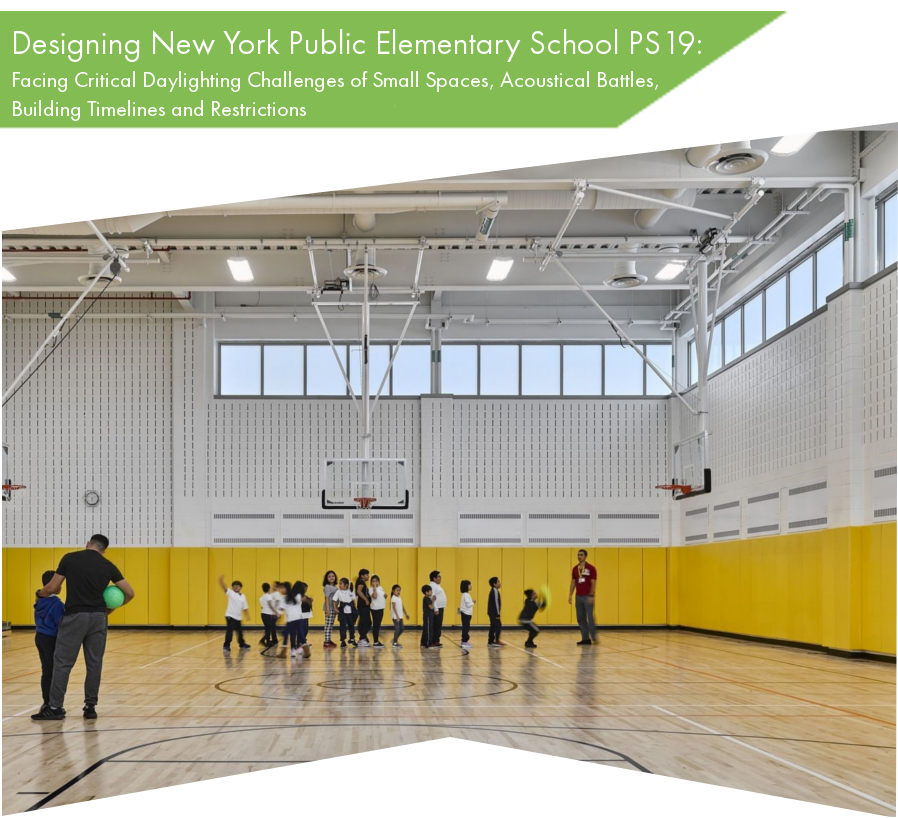
The natural daylight inside the PS19 Gymnasium is a perfect example of the power of superior daylighting. Students love being in this space during school hours, after-school activities, and weekend sport events. “Hotspots cause distraction for students playing sports in the gymnasium, especially a game like basketball. You wouldn’t be able to see the lines when playing causing disturbance in players’ ability and the game,” continued Butler.
The Impact: 3,000 Students, Lights Off, Train Noise Gone
With almost 3,000 students to teach, educators, teachers, and instructors embraced the new space with open arms. The abundant natural light entering this building from the north, south, and west-facing daylight windows help make this bright and airy gymnasium home to so many, 5 days a week.
The acoustic performance was transformative: Despite the #7 train running directly adjacent to the school, the gymnasium provides a quiet, comfortable learning environment. Students can focus on sports, learning, and activities without constant subway noise disruption—a critical factor for 3,000 students using the space daily.
Not only does Solera® provide a comfortable and natural daylighted space with a beautiful aesthetic, it also offers a significantly reduced energy load to the gymnasium by decreasing the electricity energy used by leaving the lights partially or fully off during daytime hours. “The lights could be turned off to do most activities in the gym during the daytime,” continued Butler.
Light-redirecting glass for daylight made this space a student favorite—a comfortable gym every student loves to play in.
The Takeaway: Urban Schools Need Integrated Solutions
PS19 proves that urban schools face unique challenges that vision glass can’t solve: aggressive timelines, acoustic barriers for subway noise, hotspot elimination for sports, and energy efficiency. When a subway train runs directly adjacent to your building, superior acoustic performance isn’t optional—it’s essential. Solera®’s ability to, in one integrated solution, handle the daylighting, acoustic, and thermal elements of this façade made it the optimal choice for this school.
The Design Success:
✓ **18-Month Fast-Track Timeline:** Easy installation with no questions for installers
✓ **#7 Train Noise Eliminated:** Solid acoustical barrier from integrated envelope—critical for 3,000 students
✓ **Superior Acoustic Performance:** Quiet, comfortable learning environment despite subway running directly adjacent
✓ **No Hotspots or Glare:** Even distribution of natural light, students can see court lines
✓ **Lights Off During Daytime:** Significantly reduced energy load
✓ **3,000 Students Served:** Bright, airy, quiet gymnasium used 5 days a week
✓ **Beautiful Ribbon Effect:** Aesthetics + functionality in one solution
Available Options: Advanced Glazings Ltd‘s engineered light diffusers, Solera® and SoleraWall®, are available in R values ranging from R2.2 – R25 for precise configuration and control of light diffusion, illumination, and thermal performance in your next project.
Photo credit: Frank Oudeman