



← Back to Insights & Resources
Why Research Labs Need Daylight (But Can’t Risk Glare)
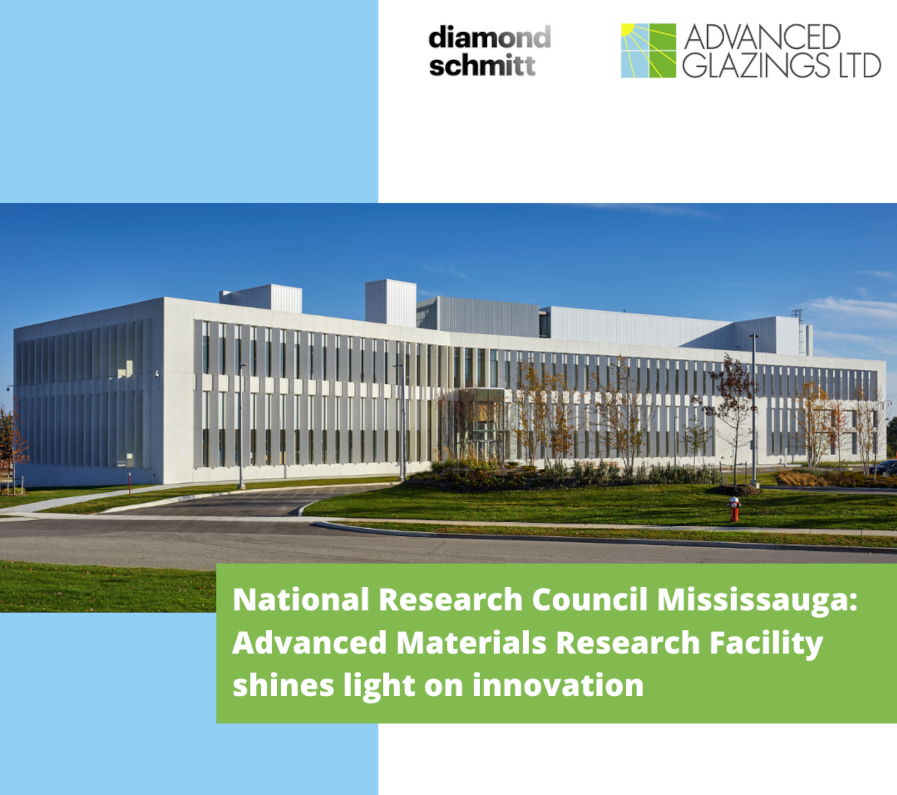
Research labs are precision environments. Natural daylight is proven to improve cognitive performance, but uncontrolled glare from tall windows can ruin experiments and make the space unusable. This was the paradox facing Diamond Schmitt Architects when designing Canada’s National Research Council Advanced Materials Research Facility.
For Canada’s new focal point for advanced materials research, the design brief was clear: create a world-class facility that supports the wellbeing and productivity of the nation’s top scientists. Diamond Schmitt Architects knew that meant maximizing natural daylight. The challenge? The design featured tall vertical curtain walls—a feature that introduces significant glare risk.
In a typical office, glare is an annoyance. In a high-performance research lab, it’s a critical failure. Glare can compromise sensitive experiments, cause eye strain for researchers working with precision equipment, and undermine the very work the facility was built for. The architects needed a way to get the benefits of daylight without the risks.
❌ The Tall Window Dilemma in a Precision Environment
Tall windows in a research lab create a unique set of interconnected challenges:
- Tall Glare Risk: The tall curtain walls, designed to bring in ample light, also created a massive aperture for uncontrolled glare, which is unacceptable in a precision work environment.
- Deep Floor Plate: With enclosed offices located in the center of the building, the design needed to drive daylight far deeper than what vision glass alone could achieve.
- Sensitive Equipment & Tasks: Researchers work with highly sensitive equipment and require a glare-free environment to maintain focus and accuracy for hours on end.
- Sustainability Mandate: The project had a clear sustainability goal to maximize daylight harvesting and reduce reliance on artificial lighting.
✓ The Solution: A Strategic Dual-Glazing System
Drawing on past project experience, Eric Lucassen, Senior Associate at Diamond Schmitt, knew a single glazing solution wouldn’t work. He had used Solera® on the Toronto Zoo Wildlife Health Centre and understood its unique capabilities. The team developed a strategic dual-glazing approach for the NRC facility.
1. Vision Glass (Lower Portion): Placed at eye level to provide researchers with essential exterior views and a connection to the outside world.
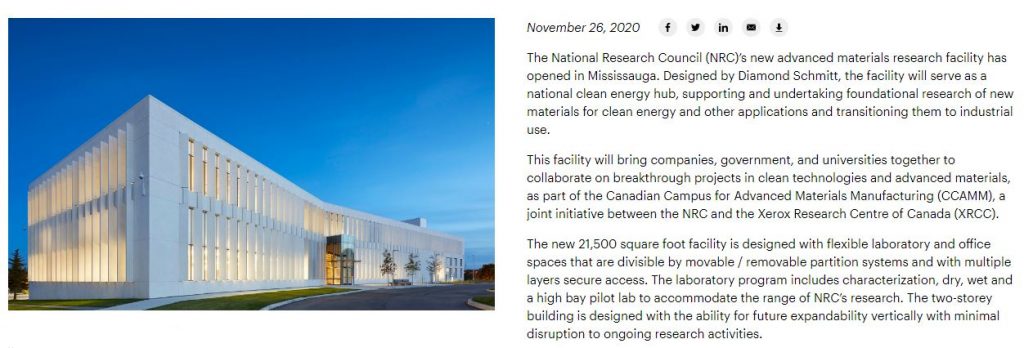
2. Solera® Translucent Glazing (Upper Portion): Used in the upper portion of the curtain wall to take advantage of the high ceilings. Solera® captures raw sunlight, diffuses it, and drives it deep into the building’s core, illuminating even the enclosed central offices without a hint of glare.
3. Precast Concrete Fins: Vertical fins at each mullion provide additional solar shading and light dispersion, while creating an expressive architectural feature.
This strategy was validated through daylight modeling, which predicted the performance and confirmed that this combination would achieve the project’s ambitious goals.
The Proof: “The Interior Lighting Doesn’t Even Need to Be On”
The ultimate proof of the system’s success is its real-world performance. The combination of Solera®, vision glass, and vertical precast fins provides such effective, high-quality natural light that, according to Lucassen, “the interior lighting doesn’t even need to be on” during the daytime.
Daylight reaches almost all areas of the facility—including the enclosed offices in the center of the building footprint—creating a comfortable, productive, and energy-efficient environment. The project is a testament to how a strategic, data-driven approach to daylighting can solve the most complex design challenges.
The Takeaway: Precision Environments Need Precision Daylighting
For research labs and other precision environments, generic daylighting solutions don’t work. You need engineered systems that deliver the right light in the right places—views where you need them, diffuse light where you need it, and glare control everywhere.
The NRC Mississauga Advanced Materials Research Facility proves that with the right approach, you can create environments where scientists thrive, experiments succeed, and artificial lighting becomes optional.