



← Back to Insights & Resources
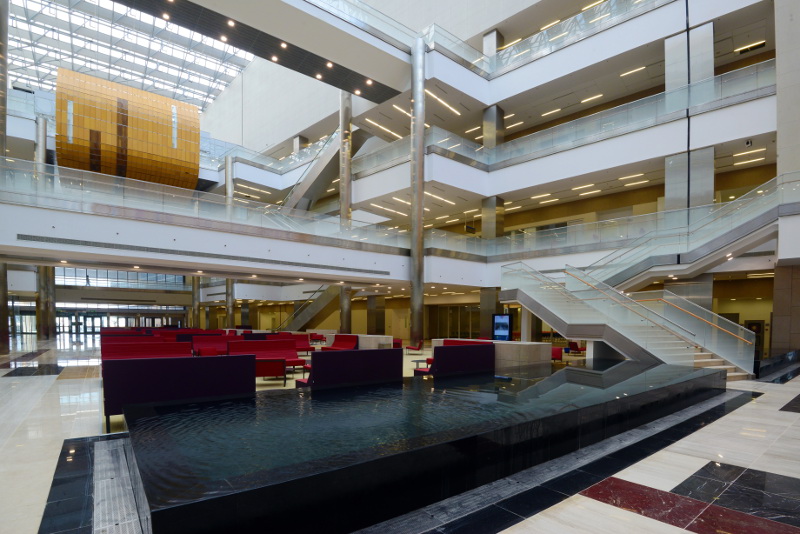
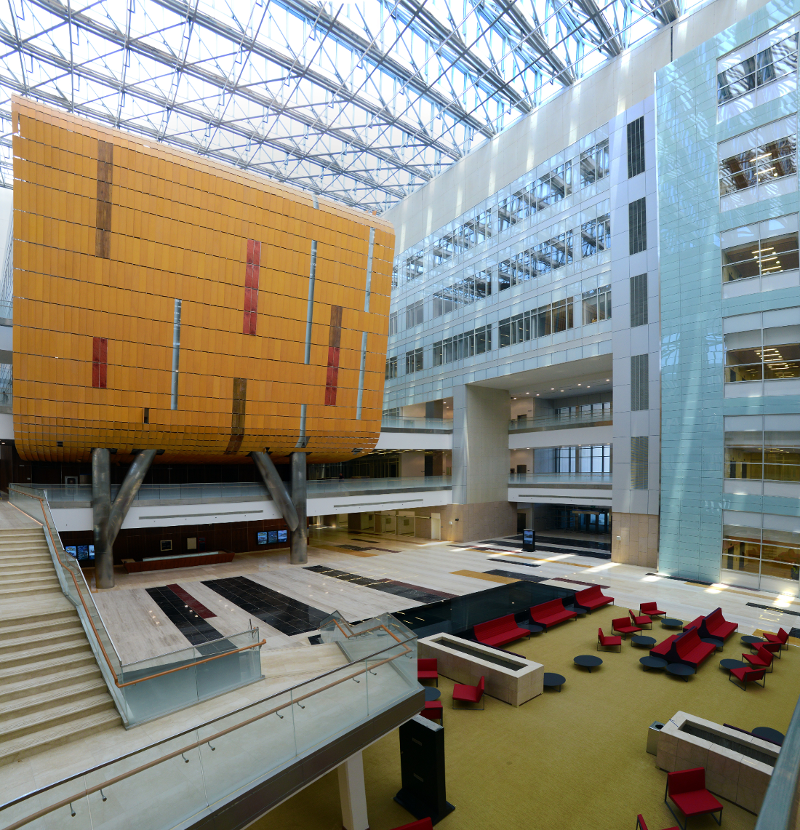
The Kuwait University College of Business Administration features a 40,000 sq ft skylight that brings beautiful, diffused natural light to 4,820 students and faculty—in one of the hottest climates on Earth.
How to Daylight a 40,000 sq ft Skylight in the Desert (Without Creating an Oven)
Imagine building a skylight the size of the Empire State Building laid on its side—in the Kuwaiti desert, where summer temperatures regularly exceed 120°F (49°C). Now imagine making that space comfortable, inviting, and energy-efficient for over 4,800 students and faculty. That was the challenge facing CambridgeSeven when designing the Kuwait University College of Business Administration.
Skylights are one of the best tools an architect can use to bring daylight deep into spaces. But in extreme climates, uncontrolled daylight creates a fundamental problem: you get the light, but you also get massive heat gain, blinding glare, and energy costs that make the building uninhabitable. The question wasn’t whether to use a skylight—it was how to make it work in one of the most challenging environments on the planet.
❌ The Desert Skylight Dilemma
Traditional glass skylights in desert climates create three critical problems:
1. Extreme Heat Gain: Direct sunlight turns the space into a solar cooker, overwhelming HVAC systems and making the building uncomfortable. In Kuwait, temperatures fluctuate between a frigid 4°C and a steaming 48°C (39°F to 118°F).
2. Blinding Glare: Uncontrolled daylight creates harsh glare that makes the space unusable for learning and working.
3. Energy Waste: Poor thermal performance means massive cooling costs, undermining any sustainability goals.
The result? Most desert buildings avoid skylights entirely, creating dark, artificial environments that disconnect occupants from the natural world.
The Vision: A Modern Greek Agora
CambridgeSeven had a bold vision for the College of Business Administration. The design called for a massive sawtooth skylight inspired by the Greek agora—an ancient public space designed for gathering and exchange of ideas—but adapted for air control in hot climates. The goal was to create white light that would diffuse deep into the space, imparting the feeling of an expansive outdoor garden.
The skylit central atrium would be the heart of the building, where informal interactions between faculty and students would foster the exchange of ideas. Smart classrooms surround the atrium to maximize student and faculty interactions between classes as they pass through the core of the university. But to make this vision a reality, they needed a daylighting solution that could deliver color-correct natural light deep into the space while maintaining thermal comfort and energy efficiency.
✓ Engineered for Extremes: Why Solera® Was the Only Choice
CambridgeSeven chose Solera® glass units at R-18 / 0.31 W/m²·K for the entire atrium skylight at design conception. This wasn’t a “skylight upgrade”—it was a fundamental building envelope decision that would determine whether the project’s sustainability goals were achievable.
Why Solera®?
1. Thermal Performance of a Wall: R-18 insulation value means the skylight performs like an insulated wall, not a thermal hole.
2. Engineered Light Diffusion: Solera® diffuses daylight uniformly throughout the space, eliminating glare and hot spots while driving light deep into the atrium.
3. Proven Through Modeling: The Advanced Glazings R&D team created a daylight model comparison showing exactly how Solera® would perform in the space—before construction began.
Visual Proof: Daylight Modeling Comparison
Daylight modeling comparison showing how Solera® diffuses light uniformly throughout the space, creating comfortable, glare-free conditions for learning and working.
The daylight modeling demonstrated that using Solera® as a separate component on the south-facing sawtooth allowed the building owner to satisfy sustainability goals while creating a visually and thermally comfortable space for students. This wasn’t guesswork—it was engineered proof.
The Result: 40,000 sq ft of Comfortable, Sustainable Daylight
The resulting sawtooth skylight, with a north-to-south orientation, was overglazed for daylighting and cooling balance using 1,126 Solera® R-18 units, creating an aesthetic of crisp lines and a variegated façade. The scale is staggering: to get a sense of the sheer size of the skylight, imagine New York’s Empire State Building laying on its side.
By the Numbers
sq ft Skylight
Solera® Units
Insulation Value
Students & Faculty
sq ft Total Campus
Certified
The result is an amazing occupant experience with beautiful, diffused natural daylight for more than 4,000 students and 820 faculty members on site. The Kuwait College of Business Administration Women and Men campuses comprise a total area of 850,000 sq ft and obtained a LEED Silver certification—a remarkable achievement in one of the world’s most challenging climates. The project was completed in 2018.
The Takeaway: Meeting Thermal Requirements Doesn’t Mean Using Less Glass
The Kuwait University project proves a critical point: meeting thermal requirements doesn’t have to mean using less glass. With the right engineered daylighting solution, you can have both—massive expanses of natural light and the thermal performance needed for extreme climates.
This is the power of engineered light diffusers. Instead of choosing between daylight and energy efficiency, architects can create beautiful, comfortable, naturally daylit spaces that people want to be in—even in the most challenging environments on Earth.